What’s New?
We’re setting up to meet with more farmers to better understand their market limitations (it’s not the busy season so they have more time).
Oh yeah, it’s a New Year! Happy 2026!🎉 New Year, new level of focus🌱

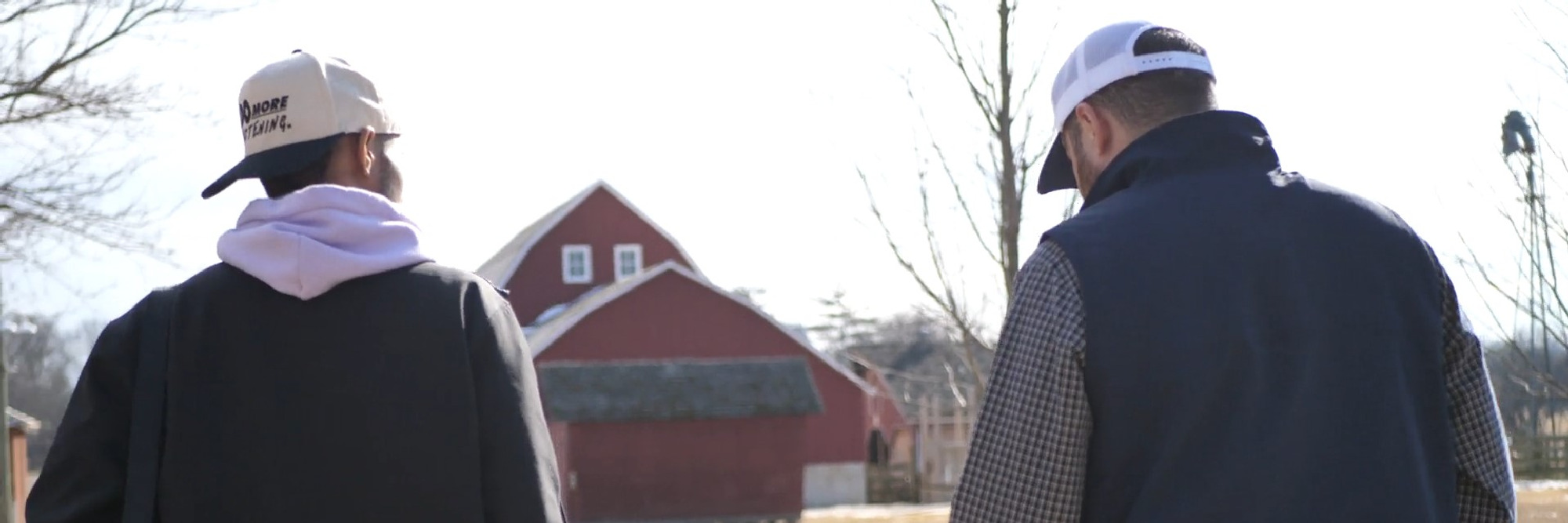
Me and Blake, a Farmer of Historic Wagner Farm out in Illinois
It was one of the most uncomfortable meetings I’ve ever had…
It wasn’t a typical meeting, we had just organized as a non profit and myself and someone close to the org met with Dion, Founder of Dion’s Chicago Dream — A non profit out of Chicago. The basis of their awesome non profit is fresh food delivery boxes sent out to folk who suffer from food apartheid.
We were brainstorming where our Non profit fit in the market and one of things my close friend said on the call was “we want to not just give people handouts, but teach them”. Dion responded, “you can’t choose how to help people that are in need of help, if a handout solves their problem, you fix it by giving them a handout.” The mood changed when he said that, I felt a bit embarrassed my close friend said that because it came off as if we devalued their non profits work or as if we’re looking to do something better than what they’re doing. Neither was the case, we we’re just making the mistake of: not understanding the nature of helping people.
Regardless of your philosophy on handouts, Dion’s comment stuck with me because it was profound. This has less to do with if we give a handout or not, but more to do with our level of understanding of the needs the people we’re serving. In order for us to move forward with Feed The Land, I needed to become crystal clear of the problem on a people level.

I spoke with Ed Dubrick, Policy Organizer and Farmer of Duchick Ranch, out in rural IL. He mentioned small farms often can’t get crop or poultry insurance like big industrial farms do. Reason being, they’re so large that virtually all government subsidies and insurance are handed to them because their use of pesticides, GMO seeds, and sterile controlled environments like CAFOs, generate more reliable yields. Local small farms don’t get the luxury of insurance because the USDA doesn’t deem it worth it. Not only because of the unpredictable nature of nature but because the local organic market is just small— it’d be like if we chose to put insurance on an electric toothbrush. If the dynamics of farm insurance interests you (and they certainly will once you realize you pay for it in taxes) check out this Chicago Tribune article featuring Ed Dubrick.
The irony is that big industrial farms are the ones receiving the “handouts…”
Local organic small farms rely on the humble contributions of their surrounding community. People simply buying their produce is a huge slice of their revenue pie. For some farmers this is the closest to “insurance” they can get. Thing is, many communities don’t know this. That’s why so much of our work is dedicated to educating folk on first the importance of real food and secondly, the importance of purchasing product from a local organic farmer!
Understanding the plight of our local organic farmer has become a hobby of mine since the last few months, I’m going to spend a few upcoming newsletters detailing it more. Talking too much about the problem can start to feel discouraging, but have no fear, you are here. You being here means you care and contribute to the solution. We are doing something about this.
Thank you for your generosity!
Nothing here is generated by AI
Happy New Year! Until next time,
Johnny - Feed The Land